Tile flooring installation in Tampa Bay.
Tile is the floor that lasts the longest in a Florida house. It is also the slowest to lay and the hardest to change later. Done right, it sits flat, the grout stays put, and it outlives the kitchen around it. Done badly, tiles crack along a slab crack, lip at the edges and sound hollow. The difference is in the slab and the mortar, not the tile.
Priced by written scope, never by the hour.
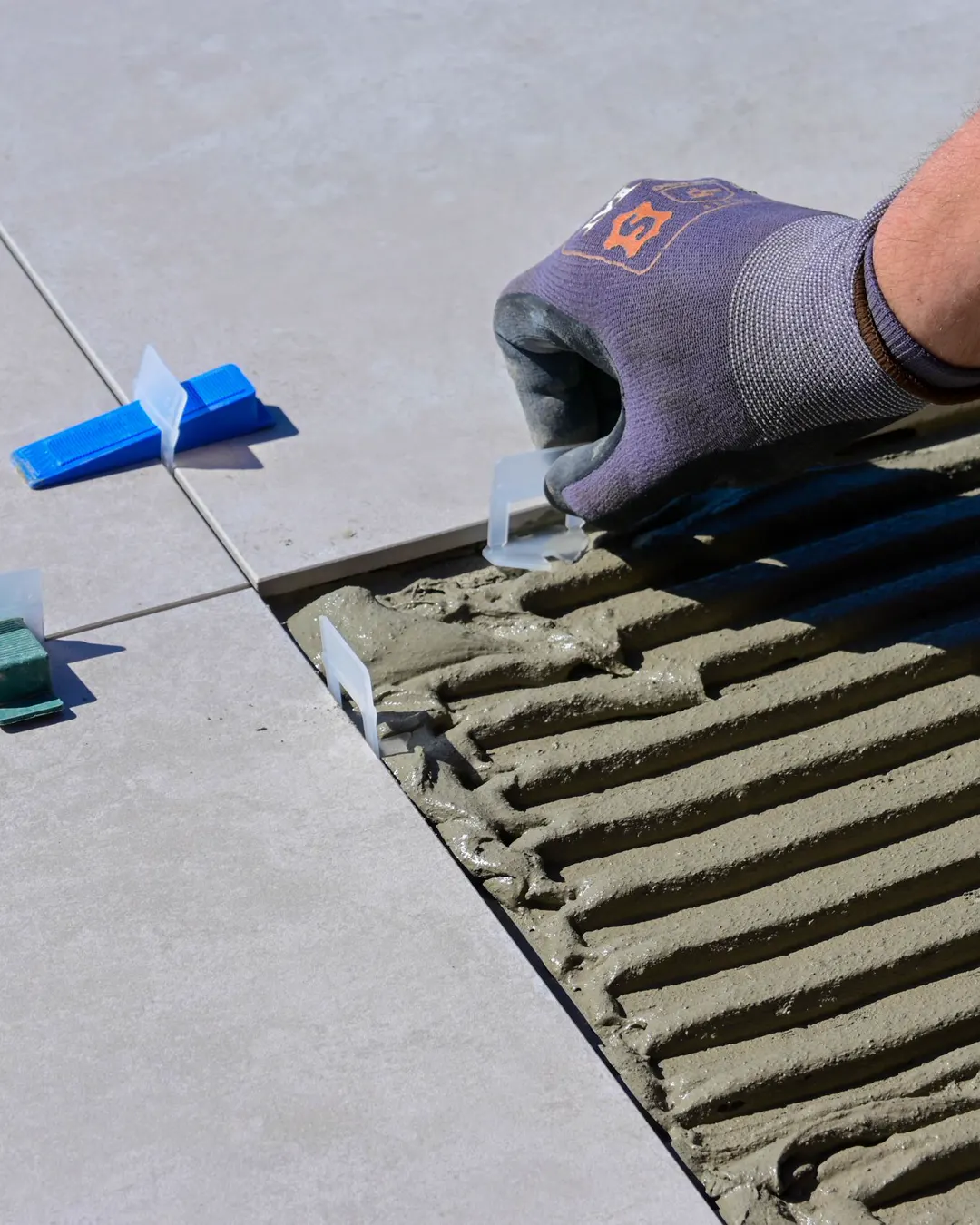
Big tiles need a flatter floor, and nobody says so.
Tile pages show you 24 by 48 planks and marble looks. None of them tells you that a big tile needs a flatter slab than a small one, by rule. Here is what to ask before you hire anyone, including us.
The flatness rule changes with the tile
The tile standard is ANSI A108.02. For small tiles it allows a floor to be out of flat by 1/4 inch over 10 feet. For any tile with an edge of 15 inches or more, it tightens to 1/8 inch over 10 feet. A big tile on a wavy slab rocks, lips and cracks. Ask how flat your slab was checked, and with what.
Lippage is the edge you feel with your foot
Lippage is one tile sitting higher than its neighbor. The standard caps it at 1/32 of an inch for narrow grout joints. Leveling clips help. They do not fix a slab that is out. Ask how the floor will be kept flat, not just level.
Mortar coverage under the tile
A floor tile needs mortar under almost all of it. The standard asks for 80 percent coverage in a dry room and 95 percent in a wet one. Big tiles get mortar on the slab and on the back of the tile, both. A hollow sound under a tile is missing mortar, and it cracks there first.
Silica dust from cutting tile
Cutting porcelain dry throws silica dust into the air. OSHA regulates it because it damages lungs. Tile is cut wet, outside or on a wet saw with water running. Ask where the cuts happen. A dry grinder in your hallway is the wrong answer.
The slab decides the price. The tile decides the rest.
Two rooms can pick the same porcelain and get very different numbers. Here is what actually separates them.
What is coming up
Old tile comes up with a chipping hammer, and the thinset under it comes up with a grinder. It is dusty, loud and slow. Carpet and glued vinyl are faster. What comes up is the biggest swing in a tile price.
The size and the layout
Big tiles and plank tiles need a flatter floor and more mortar. A diagonal or a herringbone layout wastes more tile and takes longer to cut. A straight lay of a 12 inch tile is the fastest floor. The scope names the size and the pattern.
How flat the slab is
A slab inside the standard's limit takes tile as is. One that is out gets ground, or gets a self leveling pour. The bigger the tile, the tighter the limit. This is priced after the straightedge, not before.
Cracks and movement joints
A crack in the slab reflects through tile unless it is bridged with a crack isolation membrane. Long runs and every doorway get a soft joint instead of hard grout. Both are lines in the scope, named where they go.
What gets fixed before the first tile is set.
A tile follows the slab under it, waves included. So the slab is fixed first, and each fix is priced on its own.
The slab checked with a straightedge
A 10 foot straightedge goes across the floor in several directions. High spots are marked and ground. Low spots get a patch or a leveling pour. Then it is checked again. For a big tile, this is most of the job.
Old thinset ground off
Thinset left from old tile is not a base for new tile. It is ground to clean concrete. This is the loud, dusty day, done with water and extraction. It is also the day nobody photographs.
Cracks bridged with a membrane
A hairline crack gets a crack isolation membrane over it, a foot wide or more. A crack with a step in it means the slab moved. That needs a different conversation before tile goes over it.
The layout drawn on the floor
Lines are snapped so the cuts land where they hide. The tiles center on the room, not on a wall that is out of square. A layout drawn before the mortar saves the row of slivers at the far wall.
Soft joints planned at doorways
Every doorway and every long run gets a joint filled with sealant, not grout. Tile floors move a little with heat. A soft joint lets them. Hard grout everywhere is how a tile floor tents up in August.
What is included, and where it ends.
A written scope is only worth something if it says where it stops. These are the lines we put in writing before a box is opened.
How long the room is out of use.
Tile is the slowest floor. It has two hard stops set by the product data sheets. Mortar cures before grout. Grout cures before water and heavy use. Grinding old thinset adds days. Your scope has the dates. A tile floor is a week you do not get back, so the plan names it.
When we tell you not to do it
Tile is the permanent answer, which makes it easy to sell to a room that is about to change. Here is where we say no, and why.
The slab has moved
A crack with a step in it is not a crack. It is two pieces of slab. Tile over it cracks along the same line within a year, membrane or not. That is a slab conversation first, with the trade licensed for it.
You want big tiles on a wavy slab and no prep
A 24 by 48 tile on a slab that is 1/2 inch out is a floor that rocks and lips. Either the slab gets flat, or the tile gets smaller. We will not set a big tile on a floor that fails the straightedge.
It is a rental you turn over every year
Tile is the most permanent floor and the slowest to change. If the room changes with every tenant, vinyl plank costs less to lay and less to replace. Save the tile for the rooms that stay.
The kitchen is coming out next year
Tile under cabinets that are about to move leaves a hole in the floor. Do the kitchen first. Tile goes in last, up to the new toe kicks, not under them.
Lifetime warranty on our workmanship.
If the work we did fails, we come back and fix it. That holds for as long as you own the home. On tile it means the set. The flatness we made, the mortar coverage under the tile, the grout and the soft joints.
A warranty is only worth what its exclusions say. Ours are above, in the same size type as the promise. Ask whoever you are talking to how long theirs runs, and get the number in writing.
Questions we actually get asked
Is porcelain better than ceramic for a floor?
For a floor, usually yes. Porcelain is denser and takes in less water, so it chips less and holds up on a floor. Ceramic is fine on walls and in light rooms. The box says which one it is. For a floor in a busy room we recommend porcelain.
Can you tile over my old tile?
Sometimes, if the old floor is flat, solid and the height works at the doors. It saves the grinding day. It also raises the floor, and the old tile has to be sound everywhere. Most of the time the old tile comes up.
Why do big tiles cost more to install?
Because the slab has to be flatter, by rule. The mortar also goes on both the floor and the back of the tile. Big tiles also need leveling clips and more careful cuts. The tile can cost the same per foot. The labor does not.
How long before I can walk on it?
The mortar data sheet sets the first wait, before grout. The grout data sheet sets the second, before water and heavy use. Both are in your scope. Walking on tile early is how tiles shift and grout cracks.
Do you seal the grout?
Cement grout can be sealed once it has cured, and the care sheet says when. Some newer grouts do not need it. The scope names the grout, and the care sheet tells you what to do and when.
Will the tile crack if the slab cracks?
A hairline crack that is bridged with a crack isolation membrane usually stays hidden. A crack where the slab has moved will come through. We check every crack on the walkthrough and tell you which kind you have.
The other flooring services

Where we work
Hillsborough, Pinellas, Pasco, Manatee and Sarasota counties. If your town is not on this list, call and ask: the answer is often yes.
A walkthrough, then a written scope with one closed price.
Never hourly, never a verbal figure, and our workmanship carries a lifetime warranty. Hillsborough, Pinellas, Pasco, Manatee and Sarasota counties.